

Speed to patient is a primary driver behind the industry’s shift toward modern commissioning and qualification (C&Q) practices while still ensuring product quality and patient safety. ASTM E2500 provides a science- and risk-based framework for verifying that manufacturing systems are fit for intended use, focusing verification efforts on critical aspects that directly impact product quality and patient safety. The newly revised ASTM E2500-25 standard builds upon these principles, further strengthening the integration of Quality Risk Management (QRM), process understanding and lifecycle verification strategies.
Key updates introduced in ASTM E2500-25 include:
- Introduction of Critical Design Elements (CDEs) to support control of critical process parameters (CPPs)
- Formalization of Design Qualification (DQ) earlier in the project lifecycle
- Expanded integration of QRM across system delivery and change management
- Enhanced focus on risk-based verification and lifecycle accountability
- Clarification of commissioning, qualification and verification expectations
This optimized, QRM-based project delivery model offers a powerful approach for improving project execution, reducing unnecessary qualification effort and supporting faster delivery of high-quality therapies to patients. The foundational principles within ASTM E2500 and ISPE Baseline Guide Volume 5 have already demonstrated tangible success across multiple projects—delivering ahead of schedule with improved assurance of quality. As organizations evaluate the implications of ASTM E2500-25, now is the time to assess current practices and determine how the revised framework can support operational excellence, regulatory readiness and more effective C&Q execution.
What’s New in E2500-25? Changes & Impact
The ASTM E2500-25 revision expands and clarifies several core elements of the standard while reinforcing a science- and risk-based approach to C&Q.
ASTM E2500-25 at a Glance
- Introduces CDEs
- Formalizes DQ
- Expands QRM
- Strengthens verification planning and traceability
- Clarifies C&Q expectations
- Reinforces risk-based verification over duplicate testing
Together, these updates strengthen the connection between process understanding, system design and verification activities, providing a more structured framework for demonstrating that manufacturing systems are fit for intended use.
CDEs and DQ
The 2025 revision places greater emphasis on establishing quality during system design and defining verification activities earlier in the project lifecycle.
- Introduction of CDEs: These are the building blocks that enable critical aspects of manufacturing systems to consistently control CPPs and support product quality.
- Formalization of DQ: DQ is described to ensure systems are designed with quality and compliance embedded from the outset. DQ is an early proactive tool used to document risk mitigations, formalize design acceptance and establish the foundation for verification planning.
- Expanded terminology and lifecycle accountability: Definitions now include Process User Requirements (PURs), General User Requirements (GURs) and the System Owner role, providing greater clarity around ownership, decision-making and continuity throughout system delivery.
Expanded Quality Risk Management and Verification Planning
ASTM E2500-25 further embeds QRM throughout the system lifecycle, strengthening the relationship between process risk, design decisions and verification activities.
- Enhanced Risk Management Integration: QRM is embedded throughout the lifecycle, from specification and design through verification, operation and change control.
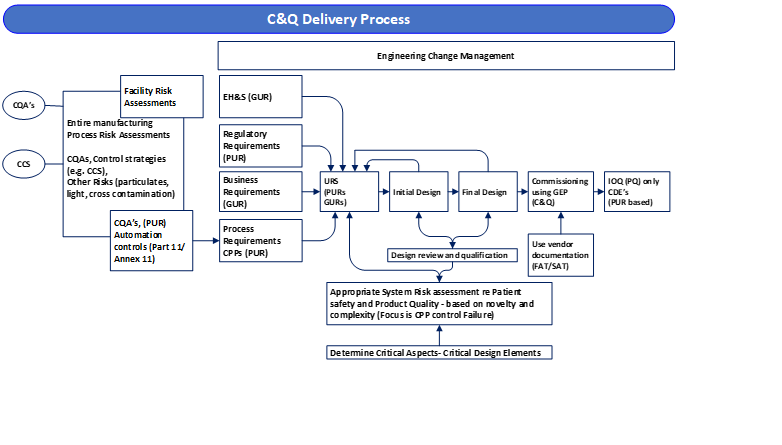
- Earlier Process Risk Assessments (PRAs): Overall PRAs are conducted prior to or during the design phase and form a key input into project delivery, process control strategies and C&Q execution.
- System Risk Assessments (SRAs): SRAs are performed in parallel with the User Requirements Specification (URS) to document Critical Aspects (CAs), CDEs, risk controls and the initial verification plan.
- Verification planning begins earlier: Design Reviews, Requirements Traceability Matrices (RTMs) and DQ activities confirm the design against the URS and proposed risk mitigations while defining where critical requirements will be verified and by whom.
- Direct linkage between process risk and patient safety: PRAs and SRAs form the critical connection between process variability, risk controls, product quality and patient safety.
Clarified C&Q Execution
The revised standard provides additional clarity regarding how commissioning, qualification and verification activities are integrated throughout the lifecycle.
- Updated C&Q delivery process: Verification activities are intended to function as an integrated process that includes commissioning, qualification, vendor testing, Factory Acceptance Testing (FAT), Site Acceptance Testing (SAT) and other Good Engineering Practice (GEP) activities.
- IOQ as a formalized review of commissioning activities: Installation and Operational Qualification (IOQ) may serve as a structured review of previously executed commissioning activities rather than requiring duplicate testing efforts.
- Clarification on qualification expectations: Qualification should focus on verification of CAs, CDEs, process controls and other elements directly associated with product quality and patient safety.
- Reduced duplicate testing: Activities adequately tested during commissioning do not need to be reperformed if verified by qualified subject matter experts and supported by appropriate risk-based justification.
- Verification effort should be risk-based: The complexity and extent of verification activities should be commensurate with the complexity, novelty and intended use of the equipment or system.
Impact on Process Control Strategy
The ASTM E2500-25 revision further strengthens the relationship between process control strategies, QRM and verification activities. By establishing clearer connections between process understanding, system design and risk controls, organizations can better ensure that critical quality requirements are addressed throughout the system lifecycle.
The revised standard impacts how manufacturers approach process control:
- From Reactive to Proactive: Instead of verifying quality post-installation, the new model ensures that systems are designed to meet CQAs and CPPs from the start.
- Alignment with ICH Guidelines: The standard now explicitly supports ICH guidelines, reinforcing global harmonization and regulatory expectations.
- Lifecycle Continuity: With the System Owner role and continuous improvement mechanisms, the standard promotes sustained control and adaptability.
Why The ASTM E2500-25 Revision Matters
Organizations that adopt ASTM E2500-25 principles can improve the effectiveness of C&Q activities while creating stronger alignment between process understanding, risk management and verification execution. The practical benefits extend beyond compliance and can influence project delivery, operational readiness and long-term system performance.
- Reduced compliance risk: Earlier integration of QRM, DQ and verification planning helps ensure that critical requirements, risk controls and regulatory expectations are addressed throughout the system lifecycle.
- More efficient C&Q: By leveraging risk-based verification principles and reducing unnecessary duplicate testing, organizations can focus resources on CAs, CDEs and activities that directly impact product quality and patient safety.
- Improved product quality and patient safety: Stronger linkage between process understanding, CPPs, system design and verification activities helps ensure manufacturing systems consistently operate as intended.
- Faster project delivery and operational readiness: Earlier risk identification, improved verification planning and greater alignment between project teams can help reduce delays during startup, qualification and facility turnover.
- Standardization across systems and projects: A structured framework for risk assessment, verification planning and lifecycle management promotes greater consistency across facilities, equipment platforms and project teams.
- Improved speed to patient: More efficient project execution and verification strategies can help accelerate the delivery of manufacturing capabilities while maintaining quality, compliance and patient safety expectations.
Implementing ASTM E2500-25 Successfully
Successfully implementing ASTM E2500-25 requires integrating process understanding, QRM, design reviews, verification planning and cross-functional collaboration earlier in the project lifecycle.
Organizations evaluating their current C&Q programs should consider:
- Reviewing existing risk assessment practices to ensure PRAs and SRAs effectively identify CAs, CDEs and associated risk controls.
- Evaluating DQ processes to confirm user requirements, process requirements and risk mitigations are appropriately incorporated into system designs.
- Aligning verification strategies with identified risks so commissioning, qualification, vendor testing and other verification activities focus on elements that directly impact product quality and patient safety.
- Establishing clear ownership throughout system delivery to support continuity between design decisions, risk management activities, verification execution and operational readiness.
- Assessing opportunities to reduce duplicate testing efforts while maintaining confidence that systems are fit for intended use.
At CAI, we partner with leading pharmaceutical and biotechnology companies to navigate complex regulatory shifts and accelerate speed to patient. Our dedicated Life Sciences team has the deep industry expertise required to guide your organization through the adoption of the revised ASTM E2500-25 framework, from proactive QRM to seamless facility turnover.
Ready to evaluate your current C&Q programs and implement a more efficient, risk-based delivery model? Contact us today to connect with our global experts and ensure your operations are fully aligned with the latest industry standards.
ASTM e2500-25 Figure 2: Commissioning and Qualification Delivery Process