
Two buzzwords, one missing ingredient
Quality Risk Management (QRM) and Operational Excellence may be the two most-used phrases in our industry. They may also be the two least understood and examined. Both appear in mission statements, slide decks and job titles far more often than they appear in a decision.
I can speak most honestly about my own side of the house. In quality, we have all seen the hollow version of QRM: the risk assessment completed after the design was frozen, written and scored by people who were handed a template instead of a process, with numbers that land just under the action threshold. It gets signed, filed and never opened again. It satisfies the expectation that a risk assessment exists. It changes nothing.
That gives us a simple test. Did the work change a decision? If a risk assessment did not change what we test, what we monitor or what we review, it was documentation, not risk management.
When QRM passes that test, the same thing is always behind it: people who truly understand the process. When it fails, that understanding is what is missing. Process understanding is the ingredient and it is also where quality and operational excellence meet.
Two halves of the same process
Operations teams have spent decades building a disciplined way of understanding a process. They know where work waits, where it loops back and which steps add time without adding value. That understanding is real, it is rigorous and in most plants it is already in place.
Quality understands the same process from a different direction. Which parameters actually affect the product? How much margin is there and where is it thin? What does failure look like before it becomes a failure? Operations understands flow. Quality understands consequence. Each is half of the picture, and an improvement in a regulated plant needs both.
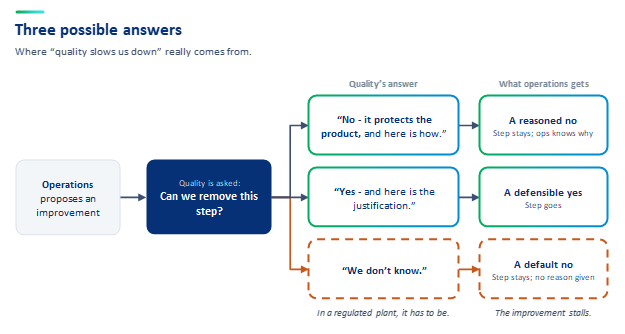
Here is where the supposed conflict between the two really comes from. Operations brings a sound proposal: this step adds no value to the flow, so can we remove it? That is a fair question, and it lands on quality’s desk. There are only three possible answers. No, because that step protects the product, and here is how. Yes, and here is the justification. Or: we don’t know.
In a regulated plant, “we don’t know” comes out as “no.” It has to. But unlike the first answer, it’s a no with no reason behind it. From the other side of the table it is indistinguishable from obstruction, and the improvement stalls in change control. When operations says quality slows things down, this is usually what they are describing. They are not wrong. Operations arrived with its half of the understanding. We did not arrive with ours.
Quality done right is what lets operations move
None of this is a failure of effort. Process knowledge on the quality side goes thin for ordinary reasons. The process was transferred in and the development history stayed with the sending site. The people who knew why a step exists have moved on. The quality team is staffed to keep pace with batch review and deviations with nothing left over for anything else.
But the consequence is worth stating plainly. In a regulated plant, operations cannot get faster by removing controls. It can only get faster by knowing, defensibly, where the controls belong. That knowledge is quality’s work. So quality is not one of several possible routes to better performance. It is the only viable one.
That is what I mean by quality as a driver. When our half of the understanding is solid, three things change for operations. Y
1. It tells you where rigor belongs
This is what QRM is for. A risk ranking built on real process knowledge is a decision tool: it says where testing, review and sampling need to be intense, and where they do not. Just as important, it is the thing you hand an inspector to defend that choice.
Without it, every step gets maximum rigor, because nobody can justify anything less. Uniform rigor feels safe, but it spends the same effort on the steps that cannot hurt the patient as on the steps that can. Proportionate rigor is faster and it is also better quality, because attention goes where the risk is. The payoff is immediate. The next validation effort is more focused and more efficient, and the next batch record review cycle is shorter.
2. It lets you hear the quiet failure
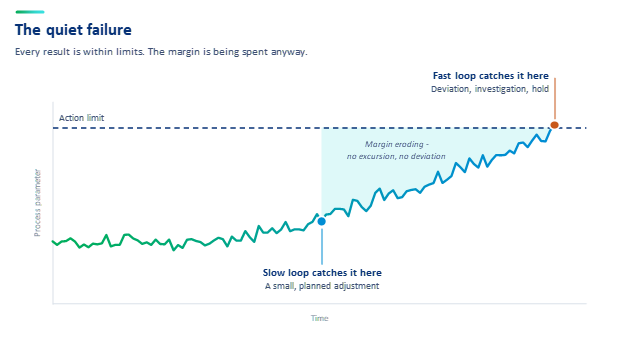
Most quality systems are built around a fast loop. Something crosses a limit, the excursion sets off an alarm, a deviation is opened and we respond. That loop matters, but it only catches failures that conveniently announce themselves.
The expensive failures are usually the quiet ones. A process drifts. Process capability erodes a little at a time. Every result is still within limits, so no deviation is written and no one is asked to look. The margin that was designed into the process is being spent, and nothing in the fast loop will say so until the day it is gone.
Catching that requires a slow loop: reading the data we already collect for direction, not just for excursions. It only works if you know what normal looks like and how much margin you started with, which is process understanding again. The operational difference is hard to overstate. An adjustment made on a trend is a small, planned event. The same problem found at the limit is a deviation, an investigation, a hold, and a schedule that no longer works.
3. It makes the bad day shorter
Things will still go wrong. When they do, the strength of the investigation decides how long operations is down and whether the problem comes back.
A team that understands its process does not start from a blank page. It already knows which inputs could produce this result, so it knows where to look first. The investigation is faster, the root cause is more likely to be the real one, and the fix is more likely to hold. For operations, that means product released sooner and a problem that stays solved, instead of one that returns every few months under a new deviation number.
What accumulates
Each of those pays off quickly. There is also a slower return, and it is the one I value most.
A site that works this way eventually notices that it is ready for an inspection without having prepared for one. There is no scramble in the weeks before, no production slowed to stage documents, no remediation program afterward. The rationale for every decision already exists, because the decisions were made with it. The site was never performing for the inspector. It was running the process the way the process needed to be run, and the evidence is a byproduct.
That is the difference between compliance and quality. Compliance asks whether the record is right. Quality asks whether the process is right, knowing that the right process leaves the right record behind. One of those is a cost that operations carries. The other is what makes operations faster, steadier, and harder to knock off course.
Right on paper isn’t right for the patient. When we in quality hold ourselves to the second standard and not the first, we stop being the function that says no, and become the reason operations can say yes.